


Labor unions took five distinct positions on immigration and foreign labor policy over roughly one hundred years. Laid side by side, the record raises a question the record alone cannot answer: whether each position reflected the stated goal, or whether the stated goal was cover for something else.
Position 1: Fight for Immigration Restriction (Pre-1924 Through 1924)
Organized labor, led by the American Federation of Labor under Samuel Gompers, was among the most sustained and organized institutional forces behind immigration restriction in the early 20th century. Their core argument was economic — waves of immigrants served to depress wages and provided ready-made pools of strikebreakers, constituting a major barrier to effective unionization.
The AFL lobbied consistently for all legislative attempts to restrict immigration, going back to the literacy test requirement in 1917. After unemployment rose following World War I, the AFL pushed for a total suspension of immigration for five years or longer. Although the final legislation was less severe, the AFL actively supported the Immigration Act of 1924.
Labor historian Joseph Rayback called the Immigration Acts of 1921 and 1924 the most significant labor legislation of the post-World War I era, noting that economic gains to workers were immediate — suggesting the AFL’s wage protection argument had genuine empirical support at the time.
The AFL fought specifically for Western Hemisphere quotas that would have restricted Mexican immigration directly. They lost that battle. The compromise produced a regulated rather than numerically capped border. This is a significant fact: the AFL’s primary target was the Mexican labor flow that would dominate the illegal immigration crisis forty years later, and they failed to close that channel in 1924.
One complication worth noting: in fighting for restriction, the AFL found itself in coalition with eugenicist and nativist groups whose motivations were racial rather than economic. The AFL’s argument was about wages. Their coalition partners’ arguments were about race. The AFL accepted this alliance as the price of achieving restriction. That uncomfortable coalition is part of the historical record.
Position 2: Oppose Bracero on Wage Protection Grounds (1942–1964)
Organized labor, now operating as the AFL-CIO following the 1955 merger, opposed the Bracero Program from its inception. Their stated rationale was consistent with Position 1: imported contract labor suppressed wages and working conditions for domestic workers.
The AFL-CIO lobbied Congress repeatedly to end the program. Their testimony emphasized that Bracero workers, bound to specific employers under contract, lacked the labor market mobility that normally disciplines wages upward. A worker who cannot quit without losing legal status cannot bargain effectively.
This was a coherent position on its face. The wage protection argument was the same logic Samuel Gompers had advanced in 1919 against unrestricted Mexican immigration and the same logic unions had applied consistently to employer-sponsored foreign labor throughout the 20th century.
What the record does not show is any serious union-sponsored effort to study whether domestic workers would actually perform seasonal agricultural labor at higher wages — the question the Depression had already answered empirically, and the question Secretary of Labor Wirtz’s 1965 domestic worker referral program would fail to answer honestly.
Position 3: Support Hart-Celler on Anti-Discrimination Grounds (1965)
While opposing Bracero, the AFL-CIO supported the Hart-Celler Act. Their public position framed the bill as a matter of civil rights — ending the discriminatory national-origin quotas of 1924 was the right thing to do.
The AFL-CIO did not publicly model the downstream labor market effects of dramatically expanded family-preference legal immigration from low-wage countries, nor did they condition their support on skills-based selection criteria that might have protected the wage floor they had spent decades defending in the Bracero context.
This combination — opposing the temporary worker program as a wage threat while supporting permanent immigration expansion without wage floor conditions — is the first structural tension in the hundred-year record. It also marks a direct reversal of Position 1: the federation that had fought hardest for restriction in 1924 now supported the legislation that would produce the largest sustained increase in low-skilled immigration in American history.
Position 4: Call for Enforcement After Illegal Immigration Explodes (1970s)
After Bracero cancellation in 1964 and Hart-Celler’s passage in 1965, illegal border crossings increased sharply. The pattern documented in Part 3 — the natural experiment of Operation Wetback demonstrating that open legal channels suppressed illegal crossings, and closed channels produced illegal substitution — played out again in compressed form.
By the early 1970s, the AFL-CIO had pivoted to calling for stricter border enforcement and employer sanctions to stop the flow of undocumented workers they argued were undercutting union wages. Their position was vocal. It was also ineffective. No meaningful employer sanctions legislation passed until 1986, and by widespread agreement that legislation was inadequately enforced.
The enforcement calls were substantively correct as a matter of labor economics. Undocumented workers employed without legal status cannot unionize effectively, cannot report wage theft without immigration risk, and create downward wage pressure in exactly the low-skill sectors where unions had historically organized. The Borjas, Grogger, and Hanson study documented negative wage effects on low-skill domestic workers, including native-born Black workers, from this period’s immigration patterns.
The meatpacking industry records the concrete result. Through the mid-20th century, meatpacking was a unionized industry paying middle-class wages. The CRS meatpacking report documents the subsequent transformation: as undocumented labor became available in the 1970s and 1980s, the industry restructured, moved to rural locations, reduced union density, and cut real wages dramatically. The workers who replaced the unionized workforce were disproportionately undocumented immigrants.
The AFL-CIO had called this outcome correctly in the abstract. It happened anyway.
Position 5: Flip to Amnesty and Immigrant Organizing (2000)
In February 2000, the AFL-CIO reversed its longstanding position on undocumented workers. The federation called for a broad amnesty for undocumented immigrants and announced a strategic shift toward organizing immigrant workers rather than excluding them.
The stated rationale was pragmatic: undocumented workers were already in the workforce in large numbers, organizing them would raise wages and conditions across the low-skill labor market, and the previous enforcement-focused approach had failed to protect domestic workers.
This position was not irrational as a labor organizing strategy. A union that can recruit millions of workers who lack alternative representation has an organizing opportunity. The question the stated rationale leaves open is whether the federation’s primary interest had shifted from protecting existing members’ wages to expanding institutional membership — and whether those two interests, once aligned, had diverged.
The 2000 position reversed the federation’s core argument from 1942 through the 1970s without resolving the underlying tension: if imported contract labor suppressed wages in 1942, and if undocumented labor suppressed wages in the 1970s as the AFL-CIO itself argued, the mechanism did not change because the federation’s organizing strategy changed.
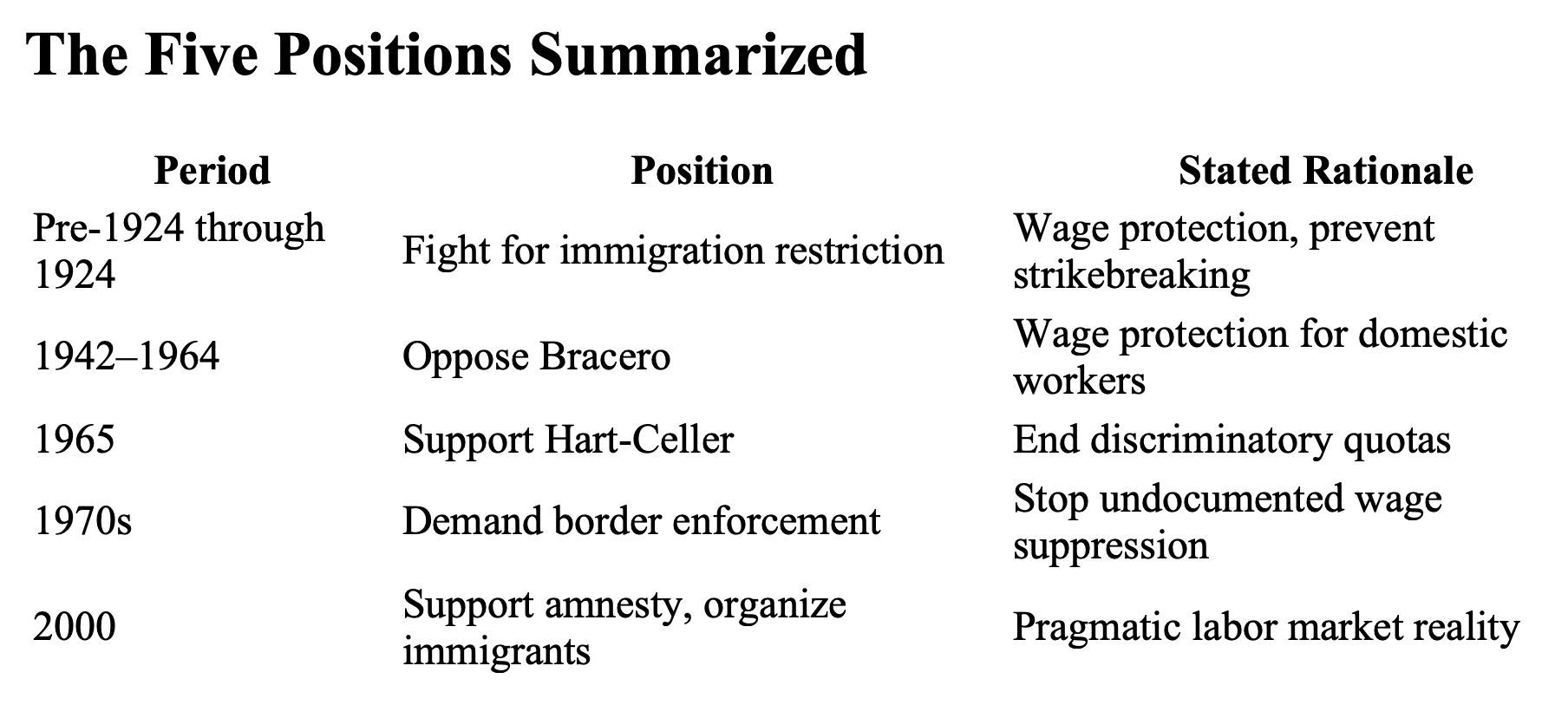
Positions 1 and 5 are in direct tension — the federation that fought hardest to close the border ultimately became one of its most prominent institutional defenders. Positions 2 and 3, taken together, reveal a structural contradiction: opposing temporary foreign labor as a wage threat while supporting permanent immigration expansion without wage floor conditions. Position 4 is analytically consistent with Positions 1 and 2 but proved operationally ineffective — the federation correctly diagnosed the problem and failed to produce the remedy.
What the Record Can and Cannot Establish
The documented record establishes the sequence of positions and the structural contradictions between them. What it cannot establish — and what this piece does not claim — is why the positions shifted, whether any shift reflected institutional self-interest over member interest, or whether the outcomes that followed each position were anticipated.
Those are questions the record raises. Readers should draw their own conclusions.
For deeper examination of the Bracero Program’s design flaws and grower incentive structures, see the companion piece “Why Growers Preferred Illegal Workers to Braceros: The Full Story.” For documentation of the wage effects on domestic workers, see Borjas, Grogger, and Hanson, NBER Working Paper. For meatpacking industry labor history, see the Congressional Research Service report on the meatpacking industry.
Please note, unlike my primary articles, I asked Claude to prepare this companion piece.