

The TRACE Act

Draft model legislation prepared for research/editorial purposes. Drafted as a standalone companion bill, intentionally separate from the CLEAN Act, to keep citizenship-eligibility auditing and ballot chain-of-custody tracking as two distinct legislative problems.
THE TRACE ACT
(Transparent Reporting and Accountability for Chain-of-custody Elections Act)
A Discussion Draft
Purpose: To authorize a voluntary, federally funded, standardized mail-ballot tracking system using Postal Service Intelligent Mail barcode technology, available to States that opt in, without mandating participation, penalizing nonparticipating States, or linking tracking data to voter eligibility determinations.
SECTION 1. SHORT TITLE
This Act may be cited as the “Transparent Reporting and Accountability for Chain-of-custody Elections Act” or the “TRACE Act.”
SECTION 2. FINDINGS
Congress finds the following:
(1) Intelligent Mail barcode tracking on ballot return and outbound envelopes is a widely regarded best practice for mail-ballot chain-of-custody administration, and has already been voluntarily adopted, in whole or in part, by numerous States and localities.
(2) A March 31, 2026 Executive Order directed the United States Postal Service to require Intelligent Mail barcodes on all mail ballots nationwide, and directed States using the Postal Service for mail voting to transmit mail-ballot recipient lists to the Postal Service, without providing funding to States or localities for implementation.
(3) The Postal Service’s proposed rule implementing that order relied on general operational authority under 39 U.S.C. §§ 401 and 404, rather than on any authority granted to the Executive Branch under Article I, Section 4 of the Constitution (the Elections Clause), which reserves to State legislatures, subject to alteration only by Congress through legislation, the authority to prescribe the times, places, and manner of holding elections for Federal office.
(4) Multiple Federal courts, including a Federal district court and the United States Court of Appeals for the First Circuit, have preliminarily enjoined implementation of the Executive Order’s mail-voting provisions in the States that challenged it, finding a likelihood that the order exceeds Executive Branch authority under the Elections Clause.
(5) A mandatory, unfunded ballot-tracking requirement imposed without Congressional authorization is likely to impose disproportionate burdens on smaller and rural election jurisdictions lacking the infrastructure to implement barcode scanning and reporting systems on short notice.
(6) Congress may, consistent with the Elections Clause, authorize and fund a voluntary, standardized ballot-tracking system for elections for Federal office without mandating its use or penalizing States that decline to participate.
SECTION 3. VOLUNTARY BALLOT TRACKING STANDARD
(a) ESTABLISHMENT.—The Election Assistance Commission, in consultation with the United States Postal Service and State and local election officials, shall establish a voluntary technical standard for mail-ballot tracking using Intelligent Mail barcode technology or a functionally equivalent tracking technology, for use in elections for Federal office.
(b) ELEMENTS.—The standard established under subsection (a) shall address, at minimum—
(1) uniform placement and format of tracking barcodes on outbound and return ballot envelopes;
(2) minimum data elements to be encoded, limited to information necessary to track the physical location and delivery status of a ballot envelope;
(3) technical requirements for State and local election offices to receive and use tracking data; and
(4) data retention and security requirements consistent with section 5.
(c) NO MANDATE.—Nothing in this section may be construed to require any State to adopt the standard established under subsection (a), or to require any State to use the United States Postal Service for the transmission of mail ballots.
SECTION 4. FEDERAL GRANTS FOR IMPLEMENTATION
(a) GRANT PROGRAM.—The Election Assistance Commission shall establish a grant program to provide funding to States and units of local government to cover the costs of voluntarily adopting the standard established under section 3, including costs of envelope stock, scanning equipment, software integration, and staff training.
(b) PRIORITIZATION.—In awarding grants under this section, the Commission shall give priority to jurisdictions with limited existing infrastructure for mail-ballot processing, including rural and low-population jurisdictions.
(c) AUTHORIZATION OF APPROPRIATIONS.—There is authorized to be appropriated to carry out this section such sums as may be necessary for each of the first 5 fiscal years beginning after the date of enactment of this Act.
SECTION 5. DATA GOVERNANCE AND PRIVACY PROTECTIONS
(a) LIMITATION ON USE.—Data collected through a tracking system implemented under the standard established under section 3 may be used solely to determine the physical location, transit status, or delivery status of a ballot envelope, and may not be used, matched, or shared for the purpose of determining a registrant’s eligibility to vote, citizenship status, or any purpose unrelated to chain-of-custody tracking.
(b) NO LINKAGE TO BALLOT CONTENT.—Tracking data collected under this Act shall not be capable of being linked to the contents of a voter’s ballot or how the voter voted.
(c) RETENTION LIMIT.—Tracking data shall be retained only for the period necessary to confirm ballot delivery and resolve delivery disputes, and in no case longer than 2 years, except as otherwise required by applicable State or Federal records-retention law.
(d) NO FEDERAL DATABASE.—Nothing in this Act may be construed to authorize the creation of a Federal database of mail-ballot recipients, or to require a State to transmit a list of mail-ballot recipients to any Federal agency as a condition of participation in the grant program established under section 4.
SECTION 6. RULE OF CONSTRUCTION
Nothing in this Act may be construed to—
(1) require any State to participate in the standard established under section 3 or the grant program established under section 4;
(2) authorize the United States Postal Service to reject, delay, or decline to process ballot mail on the basis of a State’s non-participation in the standard established under section 3;
(3) condition a State’s eligibility for funding under any other Federal election-administration program on participation in this Act; or
(4) affect any State’s authority to adopt a ballot-tracking system independent of, or in addition to, the standard established under this Act.
SECTION 7. SEVERABILITY
If any provision of this Act, or the application of such provision to any person or circumstance, is held to be unconstitutional, the remainder of this Act, and the application of such provision to any other person or circumstance, shall not be affected thereby.
SECTION 8. EFFECTIVE DATE
This Act shall take effect on the date of enactment.
Comparison to the 2026 Executive Order / USPS Proposed Rule
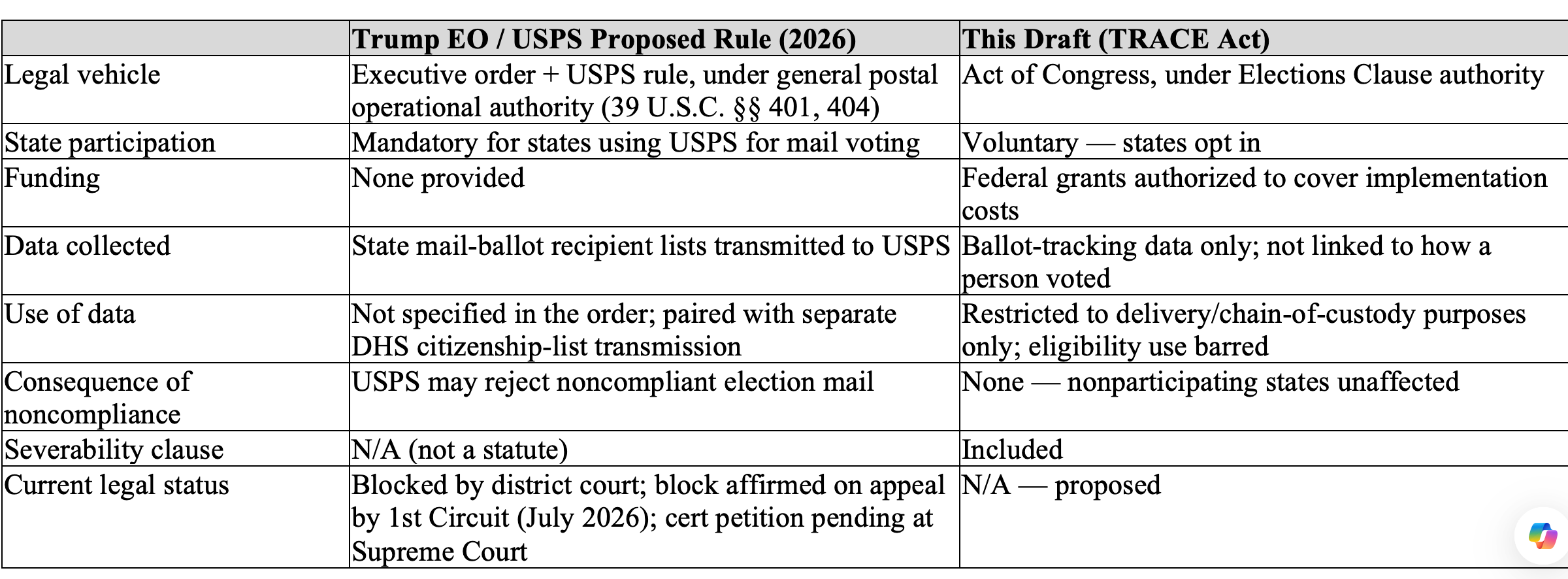
Note: This draft is a discussion vehicle, intentionally kept separate from the CLEAN Act. The two bills address distinct problems — citizenship-eligibility auditing of existing rolls, and ballot chain-of-custody tracking — and combining them into a single vehicle would blur both the legal basis and the severability protections each provision needs.